Four portable carbon monoxide monitors pilots actually name for piston cockpits: two Sensorcon AV8 meters, the Forensics car/aircraft detector, and the CO sensor built into ForeFlight Sentry. Numbers below are maker or retailer specs. A reading is not a guarantee the cabin is safe.
By a working airline pilot · How we pick · Last reviewed Sep 28, 2026 (ET)
What changed: new page. Specs and prices checked against Sensorcon, Forensics Detectors, Aircraft Spruce, Sporty’s, and ForeFlight’s Sentry pilot’s guide.
Top picks
The short version — labels come from the spec cards below.
Sentry Mini has no CO sensor. Sentry Plus uses the same 75 / 200 ppm bands and a 10-year sensor; Sporty’s lists it at $799. Receiver comparison is on portable ADS-B receivers.
Cockpit CO monitors
Pilots on r/flying and Pilots of America keep asking for a live ppm number instead of a paper dot, and they argue about whether the buzzer is loud enough under a headset. The cards stay with published specs.
Not a safety guarantee. These are portable monitors. They do not certify the exhaust, the heater shroud, or the flight. If a number climbs or an alarm sounds, the next step is the checklist and a mechanic, not a website.
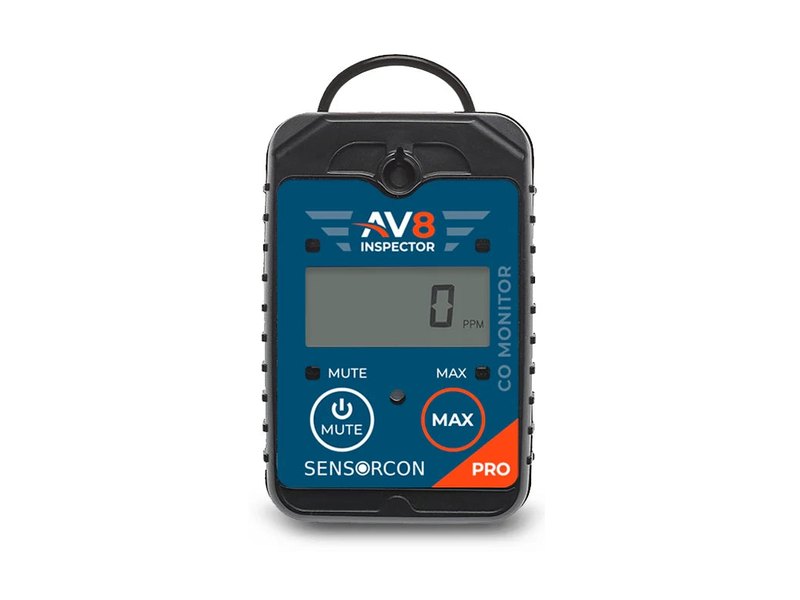
Display: LCD, 1 ppm resolution · measuring range 0–500 ppm · display range 0–1,999 ppm
Accuracy / response: ±10% of reading at ambient conditions (0–500 ppm) · T90 < 20 seconds
Alarms: Visual LCD/LED and audible buzzer, 80–85 dB · preset 35 ppm low and 200 ppm high · not adjustable on this model
Battery: Panasonic CR123A · listed life > 2 years, depending on alarm conditions · field-replaceable per Aircraft Spruce’s Q&A
Size / weight: ~3.2 × 2.2 × 0.9 in · 4 oz · electrochemical sensor · 2-year warranty
Sensor life: The AV8-CO-01 page does not print a separate sensor-replacement interval. The Pro listing’s Q&A, citing the manufacturer, says the sensor is replaced every 2 years by the manufacturer.
1 ppm numeric display, not a color spot that only changes after the fact
Published buzzer is 80–85 dB, 5–15 dB above the Forensics 70 dB figure
CR123A life is listed at more than 2 years, versus 6–8 months standby on the FD-CAR002
No vibrate. Aircraft Spruce’s Q&A says vibrate, adjustable setpoints, and 24-hour TWA are the Pro differences
An Aircraft Spruce buyer wrote that one unit ate the battery and that replacing it voided the warranty at $69 a service — the maker’s page still lists a multi-year battery
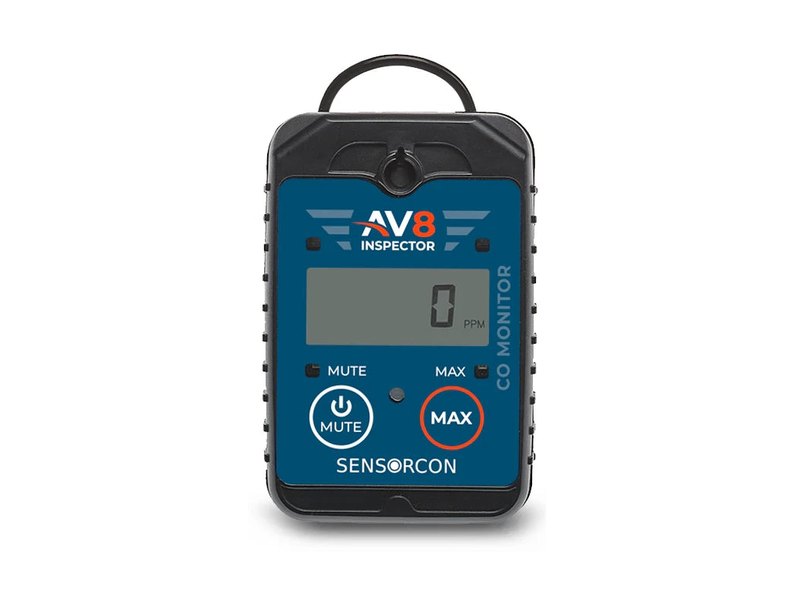
Choose the AV8 Inspector when you want a dedicated ppm meter and can live without vibrate. Vs Pro: Sensorcon’s prices were $164 and $194, a $30 gap for vibrate and adjustable alarms. An Aircraft Spruce buyer wrote that the meter in a Skyhawk “made me go looking deep for a crack… in my muffler.”
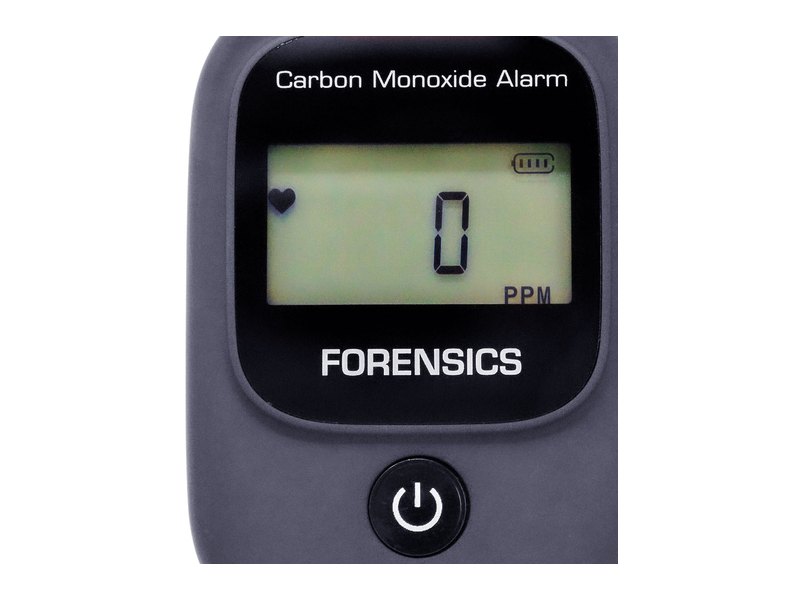
Display: LCD · 1 ppm resolution · CO detection range 9–999 ppm · accuracy ±10% of the CO reading
Alarms: Red LED at 9 ppm · audible buzzer at 25 ppm, specified as 70 dB at 1 meter · no vibrate listed
Battery: 2× CR2032 · specifications say 6–8 months on standby, shorter if it alarms. A features line on the same Spruce page says 8–12 months; the spec block is the tighter number
Sensor life: 2–3 years · lifetime listed as 3 years, with an end-of-life sticker on the back
Size / weight: 2.8 × 1.9 × 0.7 in · specifications say 3.5 oz (the overview also says 2 oz)
Price: ~$99–$124 — Forensics listed a $99.00 sale price and a $175.00 regular price; Aircraft Spruce listed $123.75 (part 13-25608). Sporty’s also lists a Forensics vehicle and aircraft detector at $99.00 with a 9 ppm LED and a 25 ppm / 70 dB buzzer
Numeric LCD that starts at 9 ppm, with the first light at that same 9 ppm point
Sale price on the maker’s page was $99, against $164 for the AV8 Inspector
Smaller than the AV8 (0.7 in thick vs about 0.9 in) and lighter on the spec sheet (3.5 oz vs 4 oz)
70 dB at 1 meter is quieter on paper than the AV8’s 80–85 dB buzzer, and there is no vibrate
Standby battery is listed in months, not the AV8’s “more than 2 years”
Choose the FD-CAR002 when you want a ppm readout and the lower price, and you will change CR2032 cells on the 6–8 month standby schedule. Vs AV8: you give up the louder published buzzer and the longer battery claim.
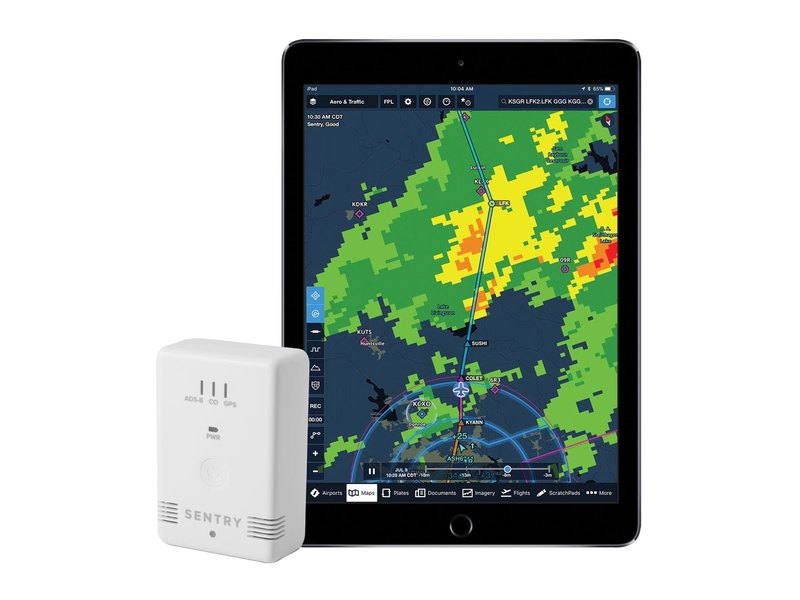
CO display: LED on the receiver. ForeFlight’s Sentry pilot’s guide: green / normal below 75 ppm, yellow / caution from 75 to 200 ppm, red / danger above 200 ppm. The ppm number is shown in the ForeFlight alert, not as a dedicated meter face
Alarm: Audible alarm above 200 ppm, plus an in-app alert. A second in-app alert follows if the level stays above 200 ppm. ForeFlight does not publish a decibel rating on the pages used here
Sensor life: 10 years, and the sensor is not replaceable (Sentry pilot’s guide and ForeFlight’s Sentry support page)
Battery: Internal rechargeable, up to 12 hours. This is the whole receiver, not a CO-only cell
Also in the box: Dual-band ADS-B (978 and 1090 MHz), FIS-B weather, WAAS GPS, AHRS, barometer. Sentry Mini does not have the CO sensor
Price: ~$649 — Sporty’s listed $649.00 and flywithsentry.com listed the same MSRP. Sentry Plus, which also has CO, was $799 at Sporty’s
The CO monitor is already in a receiver many ForeFlight cockpits mount every flight
10-year sensor is the longest interval on this page; the AV8 Q&A talks about 2 years and the FD-CAR002 lists 2–3 years
Alert path is LED, sound, and the iPad, so it is not only a buzzer under the headset
Not a 1 ppm cockpit meter. Bands are 75 and 200 ppm, coarser than the AV8’s 35 ppm low alarm
You are buying a ~$649 ADS-B receiver. A dedicated AV8 was $164 at Sensorcon
Choose Sentry for CO when you were already buying the receiver. Vs a dedicated meter: keep an AV8 or FD-CAR002 if you want a number on the glareshield at 1 ppm. Weather, traffic, and battery hours are on the ADS-B page.
Maker and retailer spec pages, plus the public threads where GA pilots compare a numeric meter with a paper dot. No hands-on test, and no claim that any unit here will keep a flight safe.
Sensorcon: AV8-CO-01 and AV8-CO-03. Aircraft Spruce: standard and Pro, including the Q&A on vibrate and the 2-year sensor.